Sustainable Event Planning: A Complete Climate-Conscious Checklist for B2B Event Managers
From planning to post-event review, a practical step-by-step checklist for running sustainable, eco-friendly corporate events globally.
What Does “Sustainable Event Planning” Actually Mean? It’s About Changing Your Defaults.
Picture this: a recycling bin tucked in the corner of the venue, and tote bags handed out as welcome gifts — bags that most attendees will never use again. For many corporate event managers, this passes as a “green event.” But in reality, it’s just adding eco-friendly decoration on top of the same outdated operating model.
Sustainable Event Planning means something fundamentally different. It means redesigning the decision-making criteria across every phase of your event lifecycle — from Planning → Procurement → On-site Operations → Post-Event Evaluation — so that environmental impact becomes the default consideration, not an afterthought.
The concept behind this is climate sensitivity: the awareness of climate risks and the habit of factoring environmental impact into everyday decisions. In an event management context, it means consistently asking: “How much carbon does this choice generate?”
This guide gives you a practical, stage-by-stage checklist to build exactly that habit — across every phase of your event.
Phase 1: Planning — Building the Sustainable Foundation
The sustainability of your event is determined at the planning table, not on the event floor. Decisions about budget allocation, venue selection, and attendee travel are locked in at this stage. That’s why greening your defaults here has the highest leverage.
Use the checklist below to audit your planning phase.
✅ Planning Phase Checklist
| Item | Standard | Check |
|---|---|---|
| Sustainability objective | Is a sustainability goal formally written into the event brief? | ☐ |
| Scale optimisation | Have you avoided over-estimating attendance to reduce surplus materials? | ☐ |
| Venue accessibility | Is the venue easily reachable by public transport? | ☐ |
| Green building certification | Does the venue hold LEED, BREEAM, Green Mark, or equivalent certification? | ☐ |
| Hybrid participation | Is a virtual or hybrid attendance option available to reduce travel? | ☐ |
| Catering planning | Does the catering plan include vegetarian/vegan options and a food waste reduction strategy? | ☐ |
| Carbon budget | Has a target carbon output been defined for the full event? | ☐ |
| Green team | Has a dedicated sustainability lead or team been appointed? | ☐ |
💡 Practical Tip: At the venue selection stage, set a firm requirement: “Can at least 70% of expected attendees reach this venue by public transport?” This single criterion structurally reduces transportation-related emissions before a single invitation is sent.
Phase 2: Procurement — Setting Environmental Standards Across Your Supply Chain
Green procurement is not simply “buying eco-friendly products.” It is a structured process of setting environmental criteria across your entire supply chain — and selecting vendors who meet them.
✅ Procurement Phase Checklist
① Vendor Selection
- Prioritise vendors holding environmental management certifications such as ISO 14001 or those publishing verified ESG reports
- Include a mandatory “sustainable operations” section in your RFP (Request for Proposal)
- Require vendors to submit a single-use material reduction plan as part of their bid evaluation
② Print and Collateral Materials
- Replace printed programmes and brochures with PDF downloads or QR-linked digital content — eliminate paper printing as the default
- Where printing is unavoidable, specify FSC-certified paper and vegetable-based inks
- Replace vinyl banners with reusable fabric signage or digital display screens
③ Badge and Registration Materials
- Eliminate plastic badge holders and polyester lanyards
- Evaluate the use of 100% paper badges as the standard
- Calculate badge quantities precisely based on confirmed registrations — prevent over-production
④ Food and Beverage
- Ban single-use plastic cups, straws, and containers
- Prioritise local or regional caterers to reduce supply chain food miles
- Establish a plan for donating or composting surplus food after the event
💡 Badge Material Note: “Recycled PET-coated badges” may appear eco-friendly, but composite materials often make them non-recyclable. A single-material, 100% paper badge carries the lowest environmental burden at end of life — and is the safest choice for ESG compliance.
Phase 3: On-Site Operations — Going Paperless at Registration, Check-In, and Badging
The on-site phase is where sustainability commitments become visible to your attendees — and where the highest volume of single-use waste is typically generated. Digitising your registration desk alone can eliminate hundreds to thousands of paper sheets per event.
✅ On-Site Operations Checklist
① Registration
- Implement an online pre-registration system — eliminate manual on-site paper sign-ins
- Send registration confirmations via email or SMS — stop mailing printed invitations and information packs
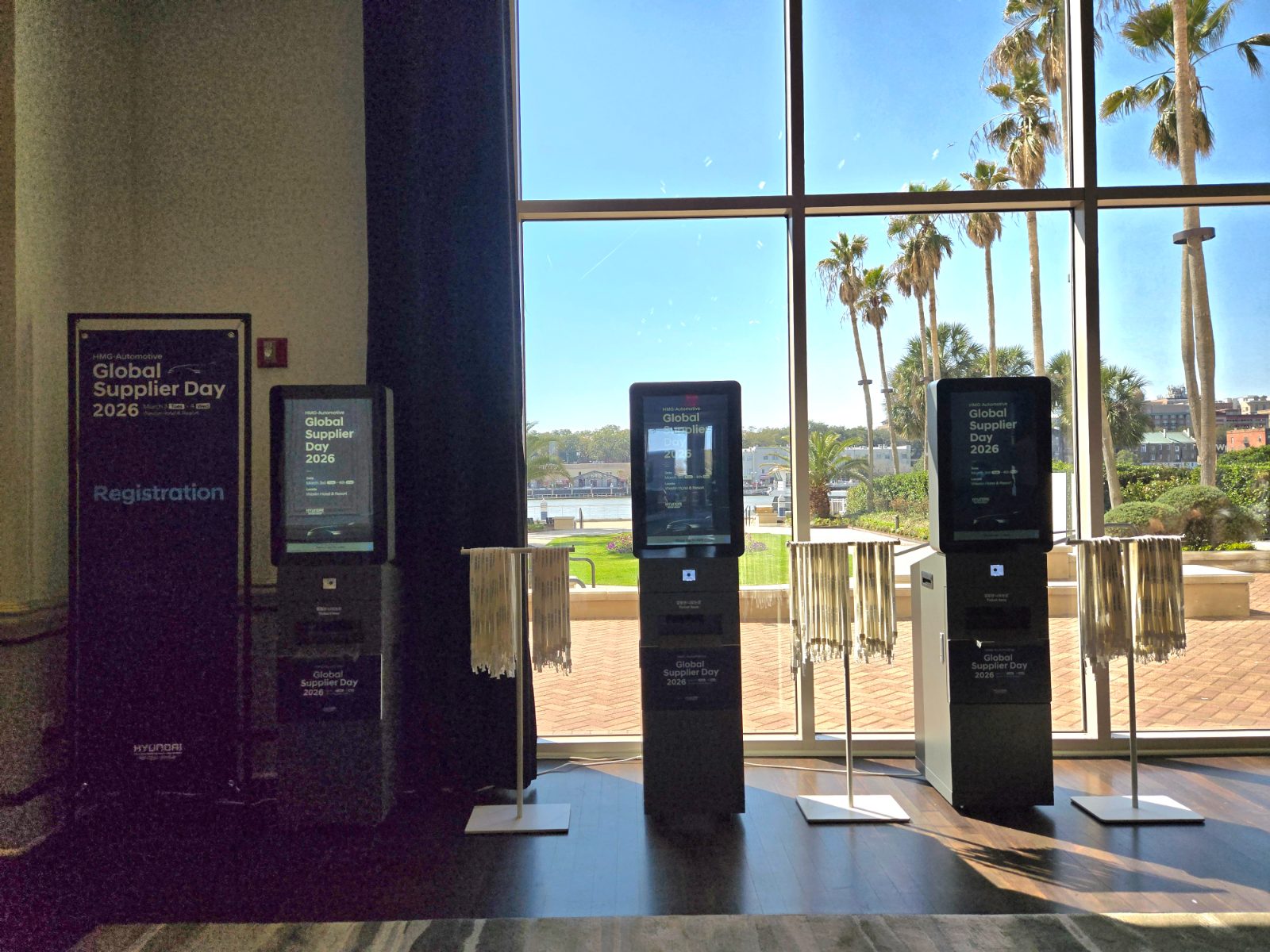
- Handle walk-in registrations via tablet or self-service kiosk
② Check-In
- Deploy QR code-based mobile check-in for all pre-registered attendees
- Use self-service check-in kiosks to reduce both staffing needs and paper consumption
- Manage the live attendee list digitally in real time — ban printed attendee rosters at the desk
③ Badge Printing
- Discontinue pre-printed bulk badge production — switch to on-demand badge printing at the point of check-in
- Use 100% paper badge stock — remove plastic sleeves and laminated coating
- Collect badges from attendees at the exit for recycling or natural decomposition disposal
④ In-Event Operations
- Distribute session slides, schedules, and speaker materials via event app or QR link
- Use digital signage throughout the venue — remove printed directional and programme signage
- Collect attendee feedback exclusively through digital survey tools — no paper evaluation forms
How FAIRPASS Supports Your On-Site Digital Transition
FAIRPASS integrates the full event operations workflow — online pre-registration → QR code check-in → self-service on-demand badge printing — into a single platform, removing the need for paper-based processes at every touchpoint.
FAIRPASS self-service kiosks support on-demand printing: the moment an attendee scans their QR code, their badge prints. This eliminates the common waste scenario where hundreds of pre-printed badges for no-shows are discarded after every event.
FAIRPASS badge stock uses a patented 100% paper material — no plastic sleeve, no laminate coating required. After the event, badges can be disposed of as ordinary paper waste or left to decompose naturally.
Organisations including LG Electronics, Hyundai Motor Company, Samsung, POSCO, COEX, ADB, and APEC — over 800 in total — use FAIRPASS to measurably reduce paper and plastic waste at their events.

Phase 4: Post-Event Evaluation — Measuring Carbon and Feeding Your ESG Report
The event ending does not mean your sustainability work is done. The post-event phase is where you convert your environmental performance into data — and use that data to set a higher baseline for your next event.
✅ Post-Event Evaluation Checklist
① Carbon Emissions Measurement
| Emission Source | Measurement Method | Reference Tool |
|---|---|---|
| Attendee travel | Collect transport mode and distance via post-event survey, apply emission factors | GHG Protocol, IPCC emission factors |
| Venue energy | Convert electricity consumption from utility bills using local grid carbon intensity | IEA, national grid carbon factors |
| Catering | Calculate by food type and quantity using life-cycle assessment (LCA) data | Carbon Trust Food and Drink Guide |
| Print materials | Paper weight (kg) × emission factor | Environmental product declarations, Carbon Trust |
| Waste | Record total waste generated and disposal method (landfill, recycling, composting) | Local environmental agency statistics |
② Performance Reporting
- Calculate total carbon emissions and percentage reduction versus your previous event
- Compile quantitative results: sheets of paper eliminated, single-use items avoided, food waste diverted
- Run a post-event sustainability satisfaction survey with attendees and analyse results
- Prepare a structured data package ready for inclusion in your organisation’s ESG or sustainability report
③ Continuous Improvement Loop
- Conduct root-cause analysis on any checklist items not achieved and feed findings into the next planning phase
- Formally document this event’s green standards as the official baseline for your next event
- Incorporate vendor environmental performance scores into your next procurement criteria
💡 ESG Reporting Tip: Create a standardised Event Sustainability Scorecard template and complete it after every event. This builds a consistent, comparable data set across your event portfolio — making it significantly faster to compile the events section of your annual ESG report.
Start Your Sustainable Event Journey with FAIRPASS
Sustainable event planning does not require a perfect system before you begin. It starts with changing one default in your next event — and building from there.
FAIRPASS gives event managers the operational infrastructure to make sustainability real: online registration, QR code check-in, self-service badge printing, and real-time attendee data management, all within one platform. The patented 100% paper badge and on-demand printing system structurally eliminate paper and plastic waste at source — not as a patch, but as the default.
Your first step toward climate-conscious event management starts here.
📬 Contact Us
FAIRPASS is ready to support your next event, whenever you need us.
fairpass@fairpass.world
Changing one badge can simultaneously elevate operational efficiency, environmental responsibility, and brand value.
Ready to streamline your next event?
Get a free consultation — no commitment required.
Get a free quote →