1,000 Attendees, One Week to Prepare: How FAIRPASS Managed Check-In for NVIDIA CEO Jensen Huang's Visit to Seoul National University
FAIRPASS built a full registration and on-site check-in system in 7 days for a 1,000-person event attended by NVIDIA CEO Jensen Huang at SNU.
In High-Pressure Events, What Matters Most Is Not How Many Devices You Have — It’s How Well They’re Connected
The higher the profile of an event, the greater the pressure on on-site operations to perform flawlessly. On June 8, 2026, FAIRPASS managed the complete attendee journey for ‘Build-a-Claw @ SNU’ at Seoul National University — an event attended in person by NVIDIA CEO Jensen Huang. Our scope covered everything from pre-registration and QR-based check-in to on-demand color badge printing and access control for approximately 1,000 attendees.
Our total preparation window: seven days.
Jensen Huang, CEO of NVIDIA, delivering remarks on-site at Build-a-Claw @ SNU — June 8, 2026
From Registration to On-Site Entry — Built and Launched in One Week
Immediately after finalizing the operational scope with the SNU Robotics Research Institute, FAIRPASS deployed a dedicated pre-registration page for the event.
We configured attendee data collection, privacy consent flows, and registration confirmation emails — simultaneously preparing badge artwork, kiosk display screens, and the physical flow of the check-in area.
Once registration opened, demand exceeded all projections.
Within just a few hours, approximately 1,000 registrations were submitted — and the event reached full capacity ahead of schedule.
This is a pattern common to high-interest events: registration and entry both spike in compressed windows. That makes it critical to design not just for total attendee volume, but for:
- Projected arrival distribution across specific time slots
- Appropriate entry space and queuing capacity
- Post-badge attendee flow toward the venue interior
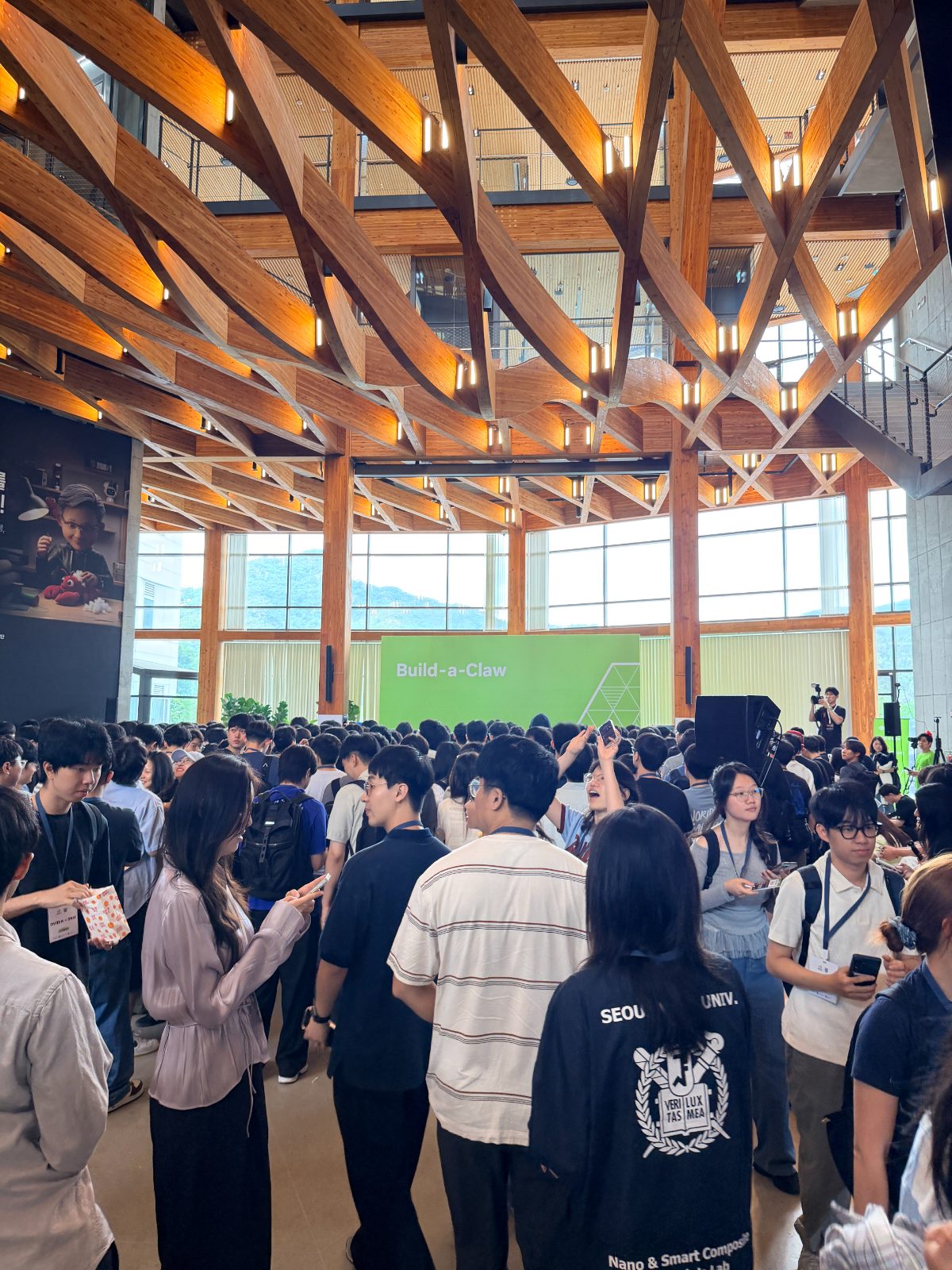
A full house — the Build-a-Claw @ SNU venue with approximately 1,000 attendees in attendance
6 Self-Service Kiosks. 1 Staffed Counter. One Unified Flow.
On event day, FAIRPASS deployed six self-service badge printing kiosks and one staffed issuance station at the venue.
Pre-registered attendees scanned their QR code at any available kiosk and received a full-color, customized badge on the spot — no searching through pre-printed stacks, no manual lookup required.
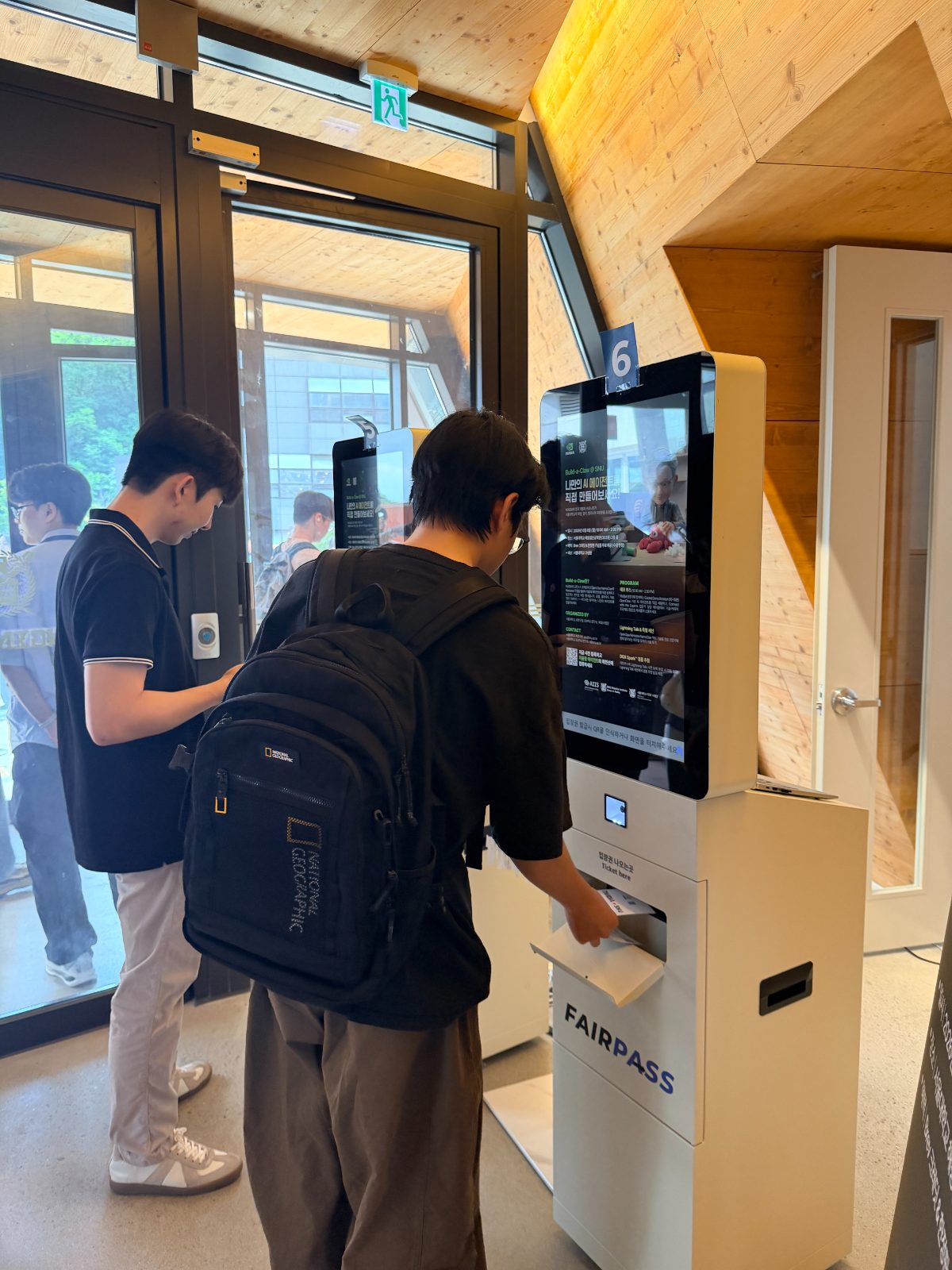
An attendee completing QR verification and receiving their badge at a self-service kiosk
Our role for this event was to ensure that all ~1,000 registered attendees could check in efficiently — and that only verified, pre-registered individuals could receive a badge and gain entry to the venue.
The multi-kiosk setup distributed attendees across parallel check-in lanes, preventing bottlenecks at any single point. The staffed counter handled exception cases, including:
- Attendees without a QR code
- On-the-spot information verification or corrections
- Invited press and influencer check-in
- Badge reprints
By letting the kiosks absorb the standard volume at speed, operations staff could dedicate their full attention to edge cases — maintaining both throughput and service quality across the board.
Badges Printed On Demand — Not Pre-Printed and Sorted
FAIRPASS does not pre-print and sort individual badges before an event. Instead, attendee data is synced with the badge design system, and each badge is printed at the moment the attendee arrives and checks in.
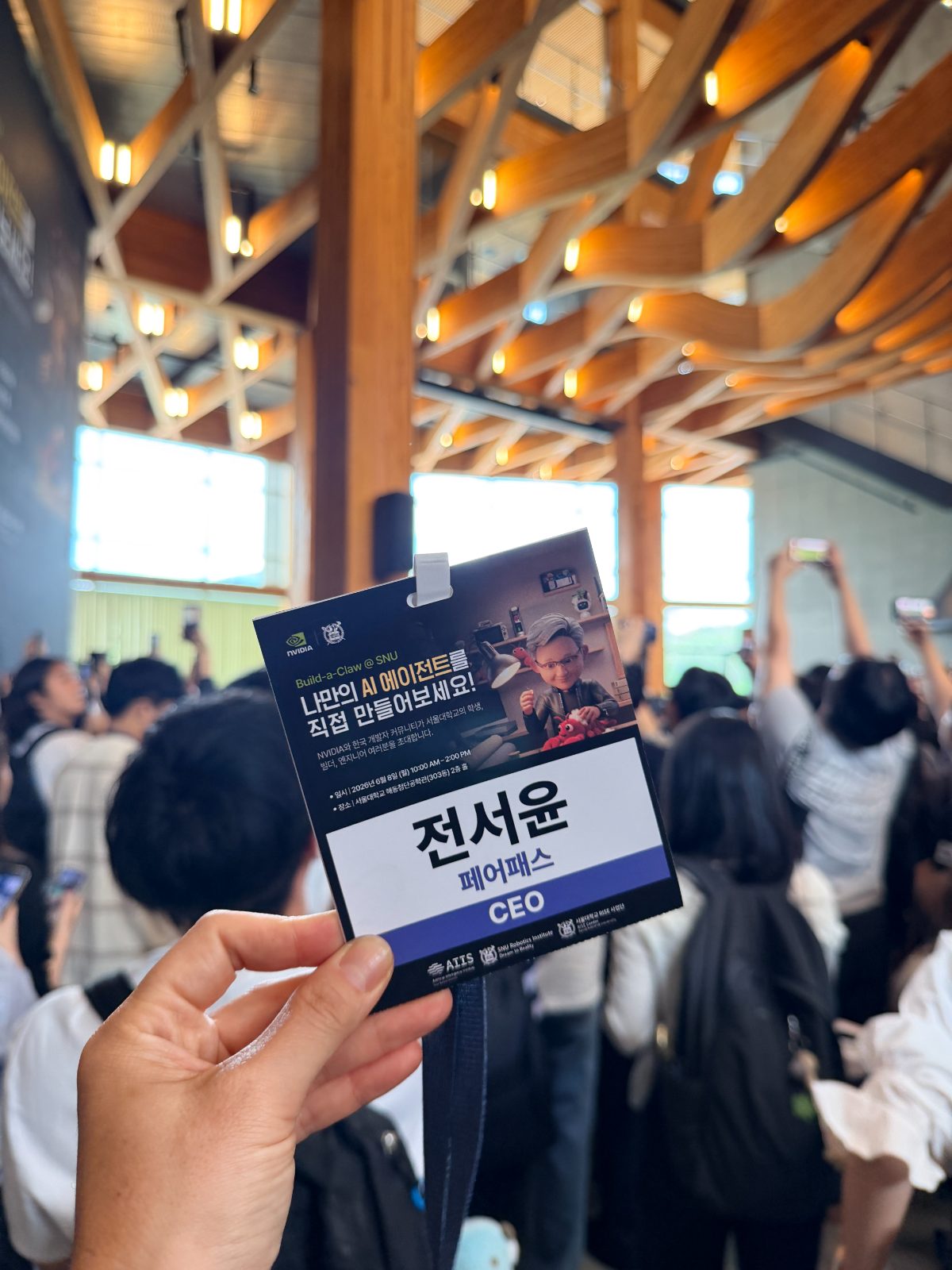
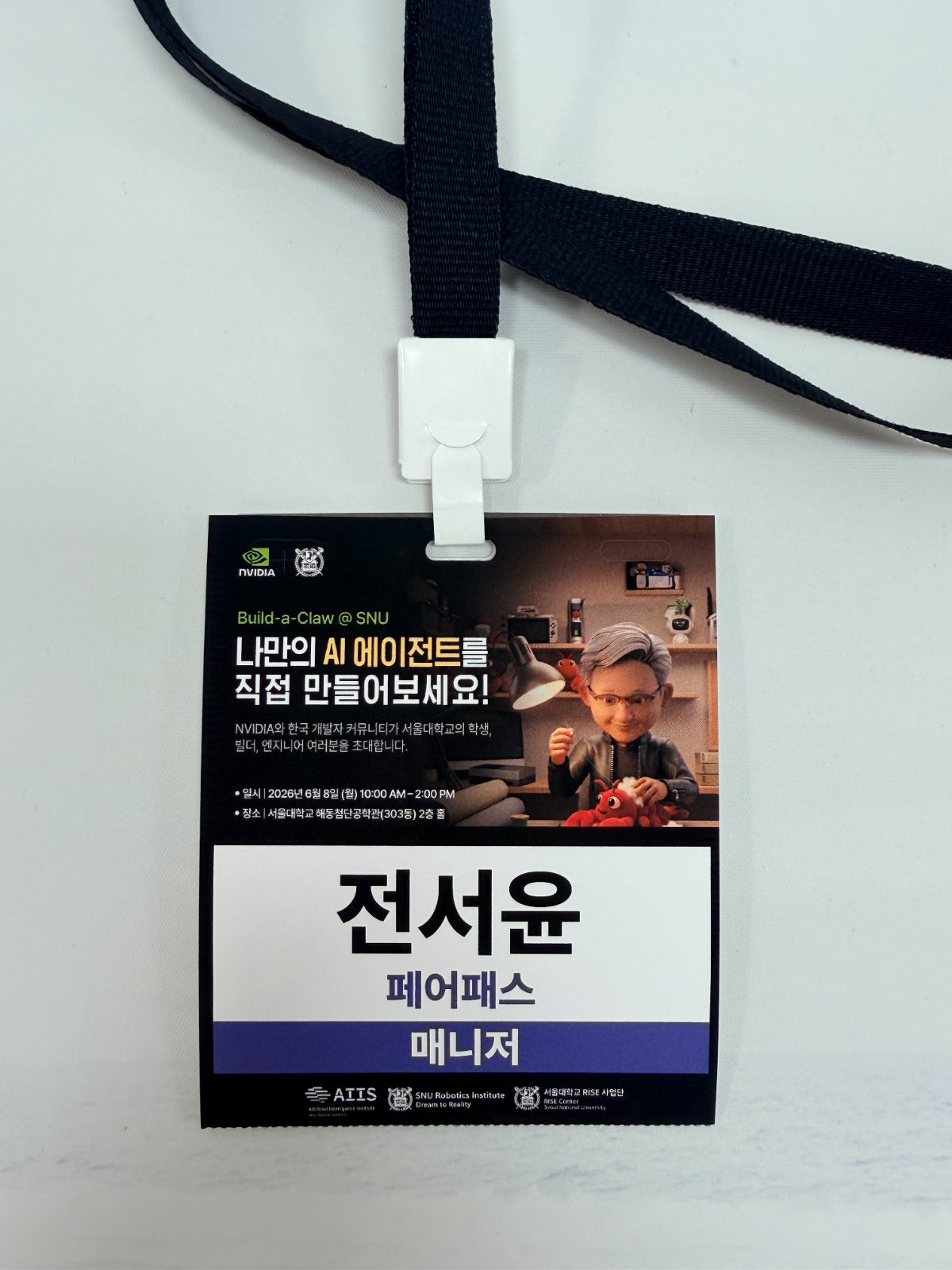
Badge front: event key visual combined with personalized attendee information
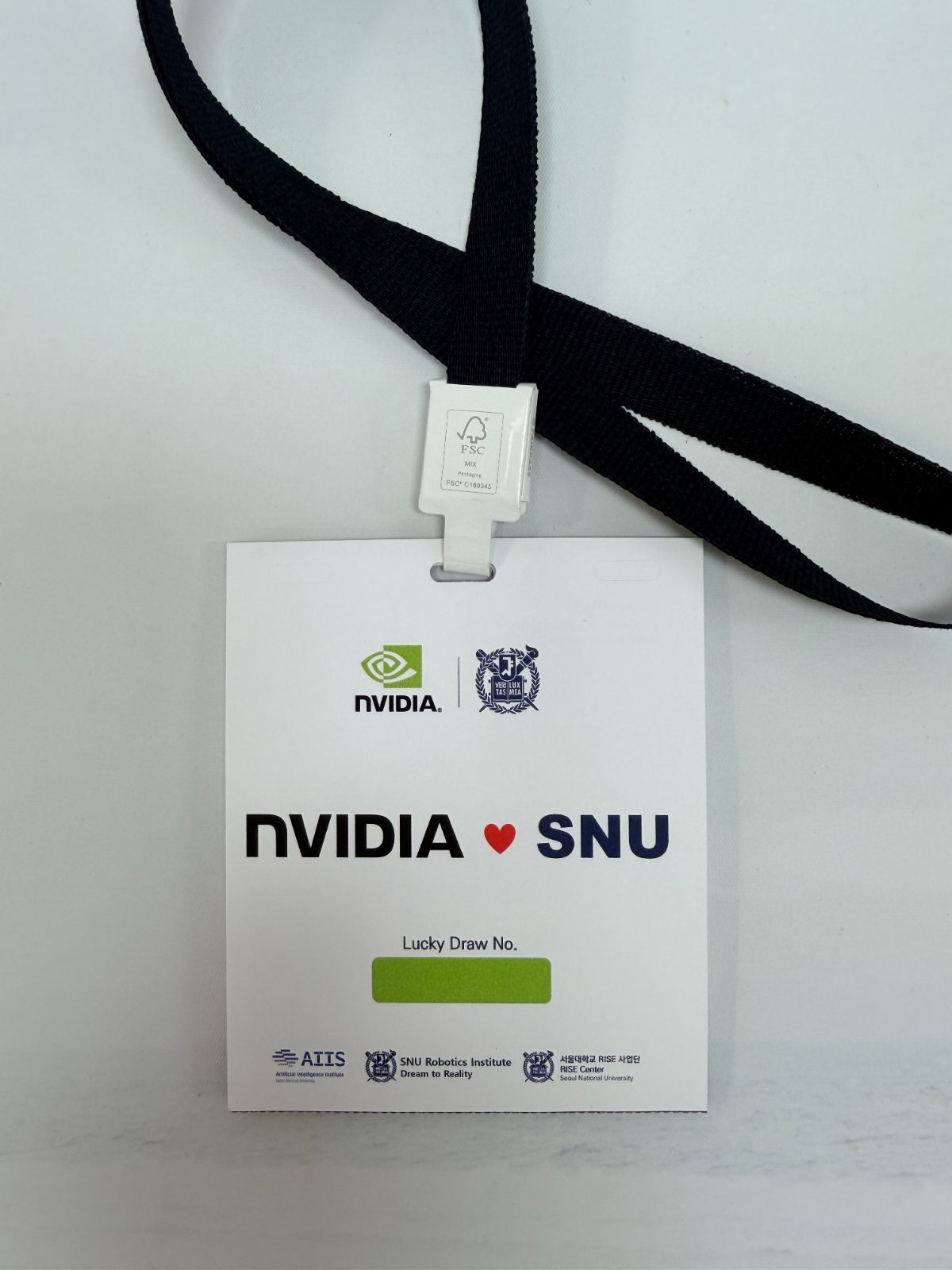
Badge back: co-branded design reflecting both NVIDIA and Seoul National University identities
Full on-demand badge issuance flow — from QR scan to color badge printout
This approach gives operations teams the flexibility to handle:
- Last-minute attendee information changes before or on event day
- Different badge designs per attendee type (e.g., general, VIP, press)
- Walk-in registrations and badge reprints on the day
It also eliminates the waste of printing badges for no-shows — a common and easily overlooked inefficiency in traditional pre-print workflows.
A badge is not just a name tag. It is the first official brand touchpoint an attendee encounters on arrival — and a meaningful part of how they experience belonging at your event.
When the Technology Is Invisible, Attendees Can Focus on the Event
An event attended by a globally recognized figure like Jensen Huang demands the highest level of operational precision. Every visible friction point — a long queue, a confused attendee, a reprint delay — reflects on the event as a whole.
The energy inside the venue — 1,000 attendees, one of the world’s most recognized tech leaders
Attendees don’t see how compressed the preparation timeline was. They simply expect to register, receive their badge, and walk into the venue without friction.
At FAIRPASS, we don’t measure success by how visible or impressive our technology looks on the floor.
We measure it by whether attendees move through the entire check-in process so quickly and smoothly that they never have to think about it at all.
That outcome requires pre-registration data, QR verification, badge printing, exception handling, and access control to operate as a single, uninterrupted flow — not as separate systems managed by separate teams.
Three Operating Principles Validated on This Event
1. Registration data and on-site systems must be a single connected system
When pre-registration data and badge issuance run on separate platforms, last-minute changes frequently fail to sync — and manual re-imports introduce errors right when you can least afford them. Connecting registration to on-site printing eliminates unnecessary steps between attendee verification and badge delivery.
2. Design the flow of people before you count the devices
Deploying more kiosks alone does not resolve queue buildup. Effective check-in design requires mapping expected arrival patterns across time slots, sizing the entry and waiting area appropriately, planning post-badge movement toward the main space, and positioning exception handling away from the primary flow.
3. Fully automated check-in still requires human judgment on the floor
Not every attendee enters through the same path. Self-service kiosks handle standard issuance at volume and speed; dedicated staff handle the cases that fall outside that path. When both work in coordination, you get efficiency and service quality — not a trade-off between them.
The Experience at 1,000 Attendees Has Opened the Door to 10,000
Following the event, the SNU Robotics Research Institute shared positive feedback with the FAIRPASS team — specifically acknowledging the team’s ability to deliver stable on-site operations under a compressed timeline and despite last-minute changes leading up to the event.
That outcome has since opened discussions with SNU regarding a potential international conference expected to host approximately 10,000 attendees, tentatively planned for the following year.
This is not yet a confirmed project. But it reflects something we see consistently: a well-executed event at 1,000 attendees builds the credibility needed to be trusted with 10,000.
High-stakes events — whether urgent, high-profile, or both — require proven technology and the operational expertise to deploy it effectively under real conditions. FAIRPASS connects every step of the attendee journey, from the moment someone registers online to the moment they walk through the venue door.
Faster entry. Smoother operations. FAIRPASS designs the first experience your attendees have of your event.
📬 Contact Us
FAIRPASS is ready to support your next event, whenever you need us.
fairpass@fairpass.world
Changing one badge can simultaneously elevate operational efficiency, environmental responsibility, and brand value.
Ready to streamline your next event?
Get a free consultation — no commitment required.
Get a free quote →